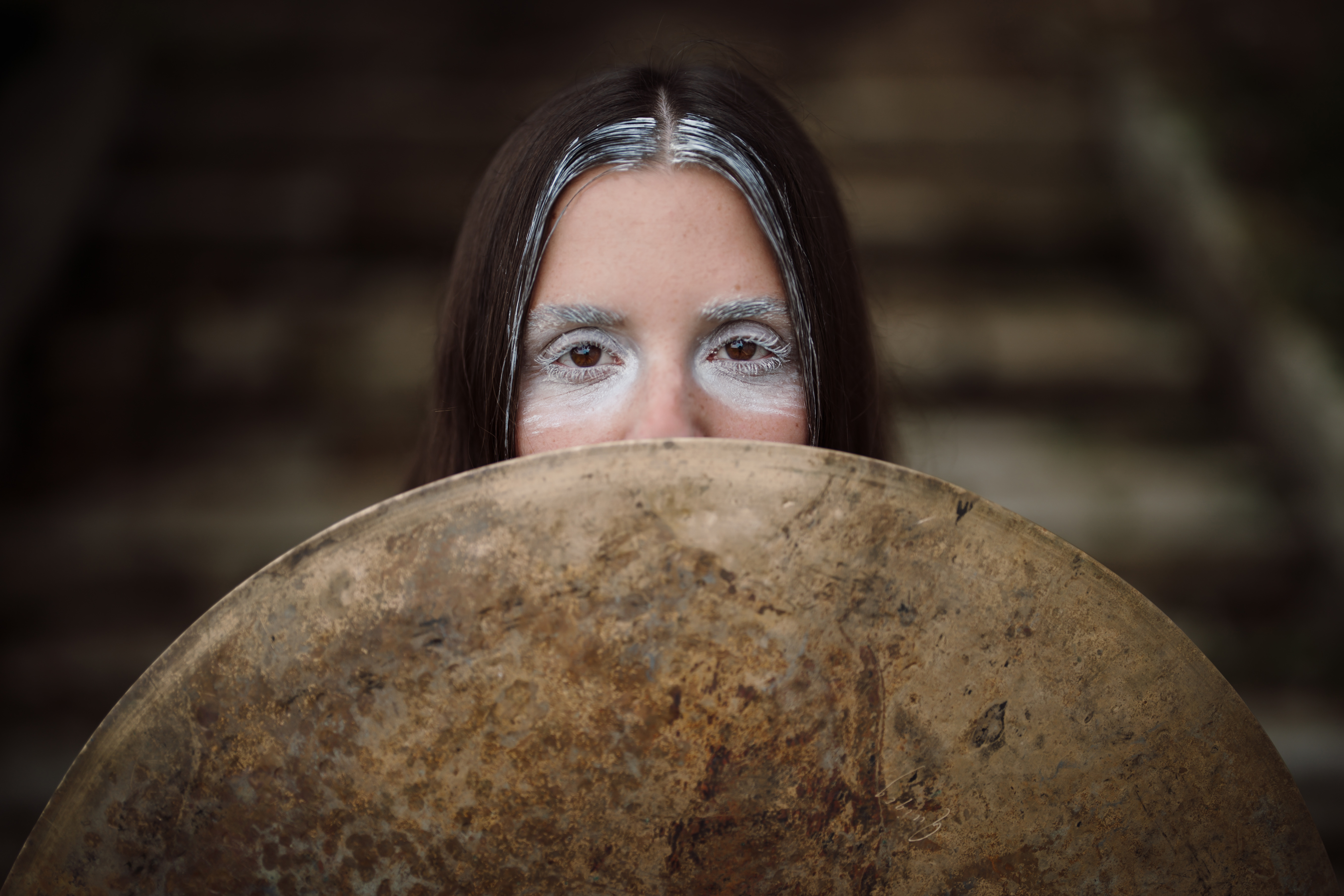

GOGODUCKS are:
Paolo Peruzzi – vibraphone and programming
Luca Zennaro – guitar, electronics
Francesca Remigi – drums, percussions
Sergio Zacco – creative coding
Andrea di Pietro della Gondola – architecture
Recorded at Artesuono Recording Studio on May 13th, 14th, 15th, 2024
Record Label: nusica.org
Mixing Engineer: Stefano Amerio
Mastering Engineer: Stefano Amerio
Video Maker: Claudio Sichel, Michele Cannas
Graphic Designer: Studio 15
TOTALE TIME: 43.44 min
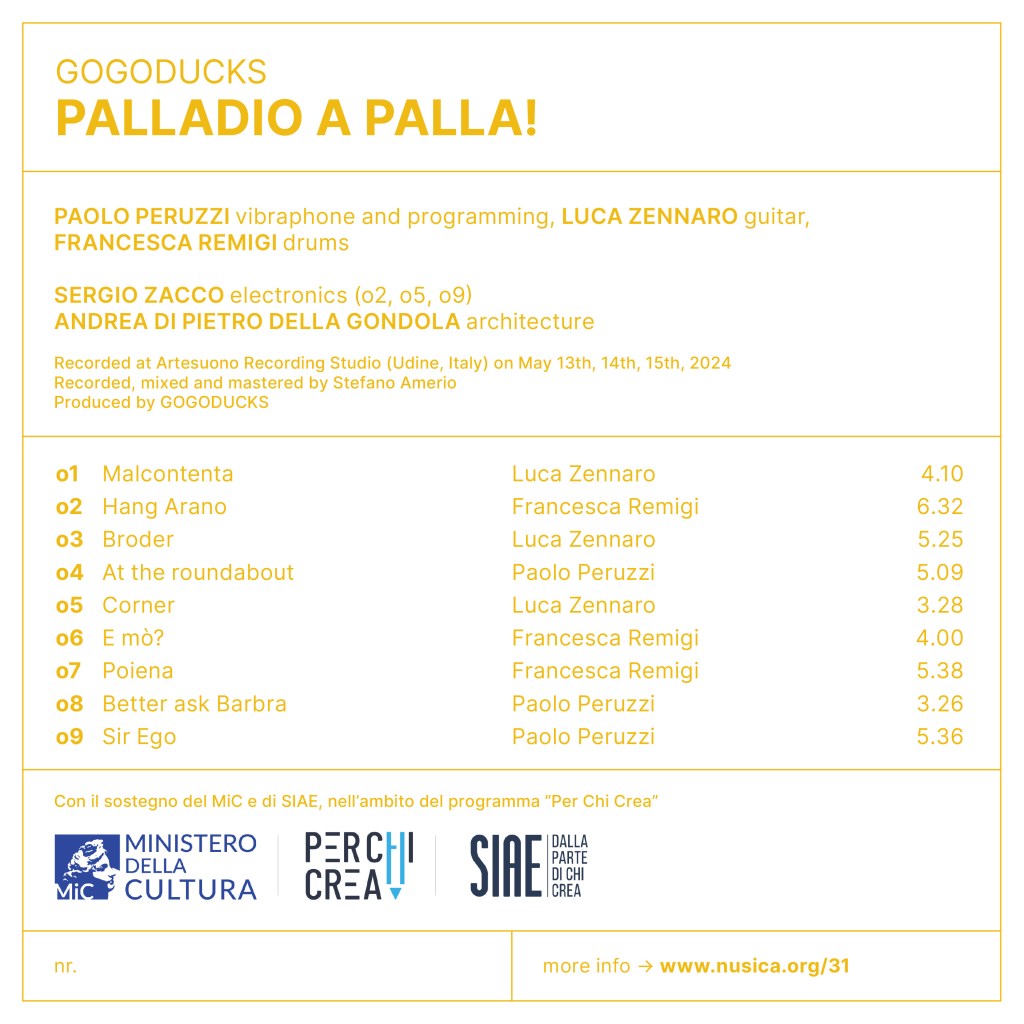
About Palladio a palla!
Palladio a Palla! is a tribute to one of the most influential architects in history as well as a recording project which aims to synthesize jazz, improvised music, architecture, and the digital world. Starting from the study of Andrea Palladio’s immense cultural heritage (Palladio is a Venetian Renaissance architect, theorist, and innovator), GOGODUCKS presents a tribute album to his architecture by translating some of the Palladio’s architectural compositional techniques into music, such as his use of rhythm, harmony, structure, energy, relationships between elements, mathematical proportion,…
The connection with their regional area brings GOGODUCKS to collaborate with Veronese creative coder Sergio Zacco. Sergio was asked to create a video-mapping project inspired by Palladio’s architectural plans and drawings to explicate the musical translation in a visual way and in order to reinterpret Palladio’s works through nowadays digital approach.
SINGLES RELEASES: July 26 (Hang Arano), August 9 (Broder), August 23 (At the roundabout)
ALBUM RELEASE: September 6, 2024
LIVE VIDEOS

GOGODUCKS BIO
GOGODUCKS is an experimental jazz trio composed by drummer Francesca Remigi, guitar player Luca Zennaro and vibraphone player Paolo Peruzzi. Together they present a contemporary and innovative repertoire of original music which looks for liquid and free approaches to music research. In an artistic journey that began in 2021, GOGODUCKS pursues the search for total
artistic honesty through the mingling of three different identities but with equal dose of leadership. The musical result takes the form of a mixture of different aesthetic outcomes, but it also strives to broaden the sonic palette of what a seemingly limited bass-less trio can achieve.
GOGODUCKS have performed at internationally renowned festivals such as Umbria Jazz 2022, the Ponte in Jazz 2022 festival, the Bari Jazz Festival 2023, Montello è Jazz 2024 and in other venues such as the Villa Lazzarino, Caffè Borsa, UnTubo, Torrione,…
Thanks to SIAE Per Chi Crea grant, the band releases its first album Palladio a Palla! on September 6, 2024, in collaboration with
audiovisual artist Sergio Zacco.
Contacts
Luca Zennaro
Address: Rione S.Giacomo 794, Chioggia (VE) 30015
Phone: +39 3466045338
E-mail: lucazennaro96@gmail.com
Tax Code: ZNNLCU97A28C638Z
Paolo Peruzzi
Address: Via Lucio III 10, 37139 Verona (VR)
Phone: +39 3473288576
E-mail: p.paoloperuzzi@gmail.com
Tax Code: PRZPLA94A03F861V
Francesca Remigi
Address: Via Mazzini 176, 24021 Albino (BG)
Phone: +39 3466417752
E-mail: f.doremigi@gmail.com
Tax Code: RMGFNC96P57A163L
 FRANCESCA REMIGI